
AI is changing the way we work. But for many Australians, the biggest question isn't which tool to try next.
It's: where do I start, and how do I know I'm using it well?
For a small business owner, that might mean finding time to experiment between customers, invoices and everything else. For an employee, it might mean wondering how their role will change. For a leader, it means helping people navigate uncertainty without dismissing their concerns.
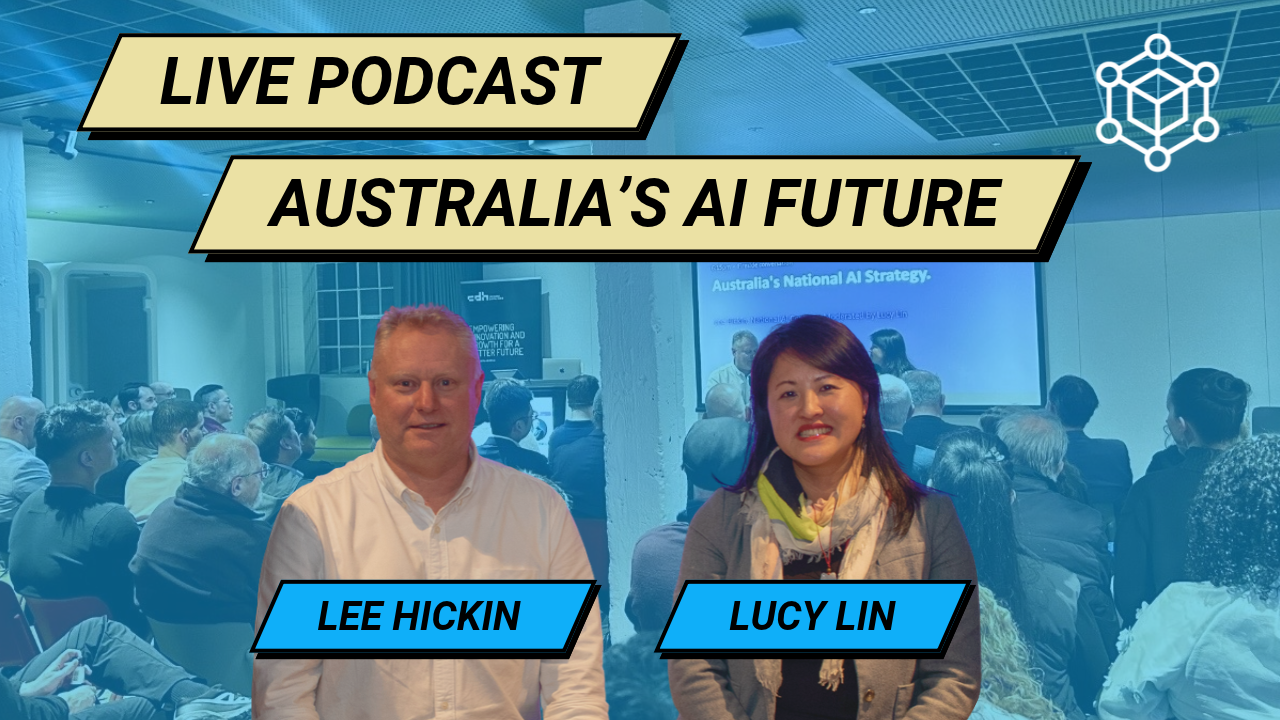
In this live episode of Emerging Tech Unpacked, I spoke with Lee Hickin, Executive Director of Australia's National AI Centre, about Australia's AI future, the skills we need and what meaningful AI adoption looks like.
Recorded at Cremorne Digital Hub in collaboration with SMEC AI, our conversation kept returning to one idea: progress depends on people, not just technology.
As Lee put it:
“You don't need to build trust in AI. You need to build your own confidence in using AI.”
AI adoption in Australia: why getting started feels so hard
When Lee speaks with small businesses about artificial intelligence, the obstacle is often more basic than a lack of technical expertise.
People don't know where to begin.
Some are frightened of making a mistake. Others feel overwhelmed by the possibilities. Many are already stretched too thin to investigate another technology.
Lee describes two versions of the same problem: people who are too worried to start and people who cannot find an entry point into something that feels enormous.
That helps explain why the way we talk about AI matters. A conversation dominated by risk can leave people afraid to act. A conversation dominated by hype can make the technology feel disconnected from their actual needs.
The more useful middle ground is practical: what problem are you trying to solve, what could AI help with, and what do you need to understand before using it?
Lee describes the National AI Centre's role as helping Australians adopt AI and find value in it, including through guidance and resources available through ai.gov.au.
AI for small business: the real benefit might be getting time back
“Productivity” features heavily in discussions about AI at work. But it isn't always a compelling invitation.
If you're already working at capacity, being told to become more productive can sound like being asked to squeeze more into the day.
Lee offers a more human starting point: time.
Less time spent on repetitive work could create room to understand a problem, develop an idea or think about the future of a business. The opportunity isn't only to do existing tasks faster. It is also to make space for work that currently gets pushed aside.
That changes the question from “How do I use AI?” to “What am I struggling to find time for?”
It also challenges the assumption that AI's value must come from replacing an existing process. As Lee says:
“AI doesn't just have to replace processes.”
Why successful AI adoption needs people on board
One story from our conversation shows how quickly an AI experiment can become a leadership challenge.
Lee described a car repair business owner who tested using AI to help prepare quotes from photographs of damaged vehicles. According to the owner, the process could shrink from around half an hour to about 30 seconds.
The technology appeared promising. But the experiment stopped.
The employees who normally prepared the quotes felt excluded and worried about their value. The owner became concerned about the implications for jobs.
Lee suggested another way to look at the situation: could faster quoting help the business serve more customers, expand its capabilities and develop employees' skills?
That was a possibility to explore, not a guaranteed result.
The important insight is that the owner and employees were looking at the same tool and seeing different futures. One saw efficiency, and others saw a threat to their contribution.
AI adoption is therefore not just about whether a tool works. It is about whether people understand why it is being introduced and can see a place for themselves in what comes next.
AI and jobs: why reassurance alone isn't enough
Will AI take our jobs?
It is one of the most emotionally charged questions in the debate, because it is rarely just about technology. It is about income, identity and security.
During our interview, I raised the experience of my own brother-in-law who works in television and his concerns about AI and employment by his colleagues in the creative industries are immediate and personal.
Lee challenged sweeping narratives about AI taking jobs, placing greater emphasis on changing tasks, evolving roles and the decisions people make about technology.
But he also acknowledged that asking people to accept reassurance is not enough.
“You can't just say, 'Hey, trust me.' That doesn't work.”
His perspective points to the need for a better workplace conversation: one that makes room for questions, explains the purpose of change and helps people develop relevant capabilities.
It doesn't settle the wider debate about AI's impact on employment. It does make one thing clear: fear about someone's livelihood deserves more than a slogan.
The AI skills we need go beyond prompting
Learning to write a prompt is one part of using generative AI. Understanding when to question the answer is another.
Lee argues that building capability means exploring a tool's limitations as well as its strengths.
Where does it make mistakes? What does it misunderstand? When does a confident-sounding answer fail to hold up?
He draws a connection with his own early experience of learning about technology: taking things apart, exploring how they worked and finding their boundaries.
That is a useful way to think about AI literacy. The goal is not simply to generate an output. It is to understand enough to judge whether the output deserves to be used.
In this sense, confidence is not unquestioning belief in AI. It comes from knowing what the technology can do, and recognising when human judgement needs to take over.
Responsible AI: less jargon, better everyday practices
For a small business, “AI governance” can sound like another layer of paperwork.
Lee prefers to connect responsible AI with practical habits: understanding how a tool is being used, being transparent with customers and remaining accountable for the outcome.
During the interview, he discussed AI6 guidance as an effort to make responsible AI adoption simpler for smaller businesses.
One example is transparency. If AI is involved in a customer interaction or service, explaining that use is part of the picture. So is giving someone a way to raise a concern with a person who can respond.
Disclosure and accountability need to work together.
This is why Lee describes AI adoption as a cultural change, not simply a technical one. Introducing a tool also raises questions about how a business handles information, makes decisions and maintains relationships.
Should Australia build its own AI models?
Australia's AI future is not only a workplace question. It is also a national capability question.
An audience member asked whether Australia should build its own large language models.
Lee made clear that his response was his personal perspective, rather than a government position. He distinguished between developing models to build Australian knowledge and research capability, and creating a model simply to compete with the largest global providers.
He saw value in developing expertise. But he also asked what problem an investment would solve and where the economic value would come from.
That reframes the debate. Instead of asking only whether Australia can build its own AI, we can ask where Australian expertise makes AI especially useful.
Lee pointed to resources, life sciences and agriculture as areas worth exploring. The emphasis was on applying technology to meaningful problems rather than treating model development as an end.
“People will pay for problems to be solved.”
What businesses and leaders can take from the conversation
Across the interview, three connected ideas stood out.
- Start with a need, not a tool. A real problem gives an AI experiment a purpose. It also creates a clearer basis for deciding whether the result is valuable.
- Treat adoption as a people challenge. A technically impressive result does not automatically create support. People need to understand the change, contribute to the conversation and see how their capabilities fit.
- Build confidence through understanding. Knowing a tool's limitations matters as much as knowing its features. Confidence should grow from informed experience, and not pressure to keep up.
These are not shortcuts to solving every AI challenge. They are a more grounded starting point for exploring what the technology could mean in practice.
Australia's AI future starts with a human question
Towards the end of our conversation, Lee encouraged a more personal approach to AI.
If someone is frightened, ask why. Listen to their concern. Share a concrete example rather than an abstract promise.
Australia's AI future has room for ambition. There also needs to be room for uncertainty, thoughtful questions and different experiences of change.
Perhaps the most useful place to begin is the question Lee poses:
“What can't you do today?”
Not because AI is always the answer. But because a meaningful need is a better starting point than the pressure to use technology for its own sake.
Watch or listen to Australia's AI Future
Join me, Lucy Lin, and Lee Hickin, Executive Director of the National AI Centre, for the full conversation on Emerging Tech Unpacked.
Recorded live at Cremorne Digital Hub in collaboration with SMEC AI, this episode explores AI at work, small business adoption, responsible use and the skills Australians need to navigate change.
Listen to the Podcast Episode:
🎙️ Website: https://www.emergingtechunpacked.com/episodes/australiasaifuture
🎙️ YouTube: https://youtu.be/Bdd3v9LQL4k
🎙️ Apple Podcast: https://podcasts.apple.com/us/podcast/australias-ai-future-jobs-skills-whats-next-live-podcast/id1734061980?i=1000800522607
🎙️ Spotify: https://open.spotify.com/episode/6FxW7SAoAKbE8CmgEHDcMC?si=XOlaJ6bsR029D_5lu8-9og
🎙️ Insights Article: https://www.lucy-lin.com/insights/australiasaifuture
Subscribe to Emerging Tech Unpacked on your favourite podcast platform or watch the episode on YouTube. Visit our website to learn more and join the conversation on social media!
🎙️ Website: https://www.EmergingTechUnpacked.com/
🎙️ YouTube: https://www.youtube.com/@emergingtechunpacked
🎙️ Apple Podcast: https://apple.co/4d6Hfoi
🎙️ Spotify: https://open.spotify.com/show/13chShsGWl7bqlQs0FZGvX?si=b7675f1bd5664c72
🔔 LinkedIn: https://www.linkedin.com/company/emergingtechunpacked
🔔 Instagram: https://www.instagram.com/emergingtechunpacked/
🔔 TikTok: https://www.tiktok.com/@emergingtechunpacked
🔔 Facebook: https://www.facebook.com/people/Emerging-Tech-Unpacked/100090565331236/
Support the Podcast!
💙 If you find this podcast valuable, consider keeping the podcast lights on and helping us cover some of our video and audio editing and operational costs: https://www.paypal.me/lucylin007007
☕ Or buy me a coffee (or three! :-): https://buymeacoffee.com/lucylin
👉 If this article was helpful, please share it and follow **Lucy Lin** and **Emerging Tech Unpacked** for more innovation and careers insights.
🚀 Contact me directly if you would like to partner or collaborate on any content, brand partnerships, sponsorship or speaking opportunities: https://www.lucy-lin.com/contact